
The VPN Illusion: Why Your Digital Privacy Is Still in Peril in 2026
In the year 2026, the digital landscape is more treacherous than ever, and millions of users cling to their Virtual Private Networks (VPNs) as a digital security blanket. They believe that with one simple click, they've become invisible ghosts in the machine, their data encrypted and their identities shielded. But is this perception a reality, or merely a cleverly marketed illusion? The truth is far more complex and, frankly, alarming. While a VPN provides a valuable layer of protection, treating it as a one-stop privacy solution is like using a paper umbrella in a hurricane—it might help a little, but you're still going to get soaked.
The Shimmering Promise: What a VPN Actually Does
Let's give credit where it's due. A VPN performs two critical functions that form the bedrock of its appeal:
-
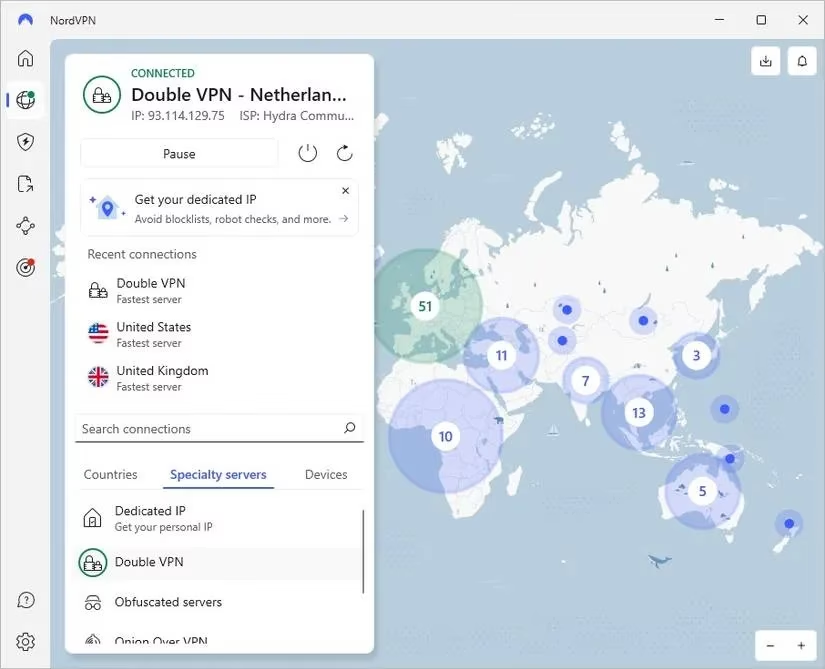
Encryption Tunnel: It creates a secure, encrypted tunnel between your device and a remote server operated by the VPN provider. All your internet traffic—every search, every click, every download—travels through this tunnel, scrambled into unreadable code for anyone trying to snoop.
-
IP Address Masking: It hides your real IP address (your device's unique online identifier tied to your location) and replaces it with the IP address of the VPN server. To any website you visit, you appear to be connecting from the server's location, not your own living room.
This magic act is incredibly useful in specific scenarios. Connecting to a sketchy public Wi-Fi at an airport? A VPN encrypts your data, making it useless gibberish to any lurking hacker. Don't want your Internet Service Provider (ISP) logging every website you visit and potentially selling that data? A VPN blinds them to your browsing habits. It's a powerful tool for adding a layer of obfuscation.
The Cracks in the Armor: What a VPN Cannot Do
Now, prepare for the cold shower of reality. Marketing materials often gloss over these critical limitations, but in 2026, they are more relevant than ever.
🚫 The Malware Blind Spot
Think a VPN is an antivirus? Think again! A VPN encrypts data in transit, but it does absolutely nothing to prevent malware, viruses, ransomware, or other malicious software from infecting your device. If you click a phishing link in an email or download a corrupted file, the VPN happily encrypts that malicious traffic and delivers it straight to your computer. The encryption protects the journey, not the poisonous cargo. Your device's security is still your responsibility.
🚫 The Unchangeable Digital Fingerprint
This is a privacy killer that VPNs are utterly powerless against. Websites use a technique called browser fingerprinting to create a unique profile of your device. They collect data points like:
-
Your operating system and version
-
Your screen resolution and color depth
-
All installed fonts and browser plugins
-
Your device's hardware configuration
This combination is often as unique as a human fingerprint. Even if you change your IP address every minute with a VPN, this fingerprint can track you across the web, building a detailed profile of your behavior. A VPN cannot alter these inherent characteristics of your system.
🚫 The Cookie Monster's Buffet
Cookies, those tiny data files, are another tracking method that laughs in the face of VPN protection. First-party cookies (from sites you directly visit) can be useful for logins. However, third-party tracking cookies are embedded across the web by advertisers like Google and Facebook. They follow you from site to site, recording your interests and actions. A VPN does not block these cookies or prevent this cross-site tracking. If you're logged into a Google account while using a VPN, Google knows exactly who you are and what you're doing, IP address be damned.
🚫 The Kill Switch Catastrophe
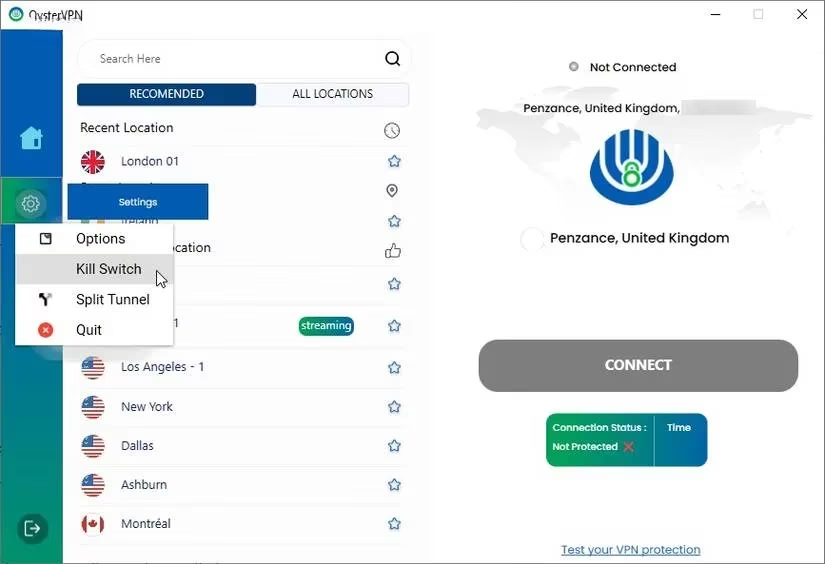
Your VPN's protection is only as strong as its connection. If that connection drops unexpectedly—even for a split second—your real IP address and unencrypted traffic can be exposed. This is why a reliable kill switch is non-negotiable. This feature automatically cuts off all internet access if the VPN connection fails. Shockingly, many users operate without this crucial safety net enabled, living in a false sense of security.
The Ultimate Betrayal: You're Just Shifting Your Trust
Here's the most unsettling truth of all: when you use a VPN, you don't make your data invisible; you simply transfer trust from your ISP to your VPN provider. You are funneling all your internet traffic through their servers. The question becomes: is this new guardian any more trustworthy?
| Concern | Explanation | The Risk in 2026 |
|---|---|---|
| Logging Policies | Not all "no-logs" policies are created equal. Some keep connection timestamps and server IDs, which can be used to identify patterns. Others, especially free services, may keep detailed logs of every site you visit. | Your VPN provider could have a more detailed dossier on you than your ISP ever did. |
| Jurisdiction Matters | Where a VPN company is based is critical. Countries in intelligence alliances like the Five Eyes, Nine Eyes, and Fourteen Eyes can legally compel companies to hand over user data. A "no-logs" claim is meaningless if the government can force them to start logging. | Your private browsing history could end up on a government server. |
| The Free VPN Trap | As the saying goes, if you're not paying for the product, you are the product. Free VPNs are notorious for monetizing user data through advertising, selling bandwidth, or even worse. | Services like the infamous BigMama VPN have been known to use users' devices as exit nodes for other users' traffic, potentially implicating you in someone else's illegal activity. |
| Provider Hacks | VPN companies are not impervious to attacks. Remember the NordVPN breach of 2018? A server was compromised, and while no user data was reportedly taken, it proved the infrastructure itself can be a weak point. In 2026, the stakes are even higher. | A hack on your VPN provider could expose the very data you're trying to protect. |
Building a Real Fortress: The 2026 Privacy Stack
So, should you cancel your VPN subscription? Not necessarily. But you must stop viewing it as a silver bullet. True digital privacy in 2026 requires a layered, defense-in-depth strategy. A VPN is just one brick in the wall.
🔒 Combine your VPN with these essential tools and habits:
-
Privacy-Focused Browsers: Use browsers like Brave or Firefox with strict anti-fingerprinting and tracker-blocking settings enabled.
-
Search Engines That Don't Track: Ditch Google for DuckDuckGo, Startpage, or other privacy-respecting alternatives.
-
Comprehensive Security Software: A robust antivirus/anti-malware suite is mandatory to catch threats a VPN misses.
-
Password Manager & 2FA: Protect your accounts from takeover with unique, strong passwords and two-factor authentication everywhere.
-
Encrypted Messaging: Use Signal or similar apps for truly private conversations.
-
Regular Updates: Keep your operating system, browser, and all apps patched to fix security vulnerabilities.
-
Healthy Skepticism: Be cautious of links, emails, and downloads. No tool can replace common sense.
In conclusion, the narrative that a VPN equals complete privacy is a dangerous oversimplification that persists into 2026. It is a valuable tool for specific tasks—bypassing geo-restrictions, adding encryption on public networks, hiding your IP from casual observers. However, it is utterly incapable of defending against the sophisticated tracking ecosystems of big tech, the ever-present threat of malware, or the potential untrustworthiness of the VPN provider itself. Your privacy is not a single purchase; it's an ongoing practice. Don't be fooled by the one-click myth. Build your digital fortress layer by layer, and always remember: on the modern internet, true anonymity is a myth, but intelligent, layered privacy is an achievable goal.