
Why Infostealer Malware Is the Cyber Threat I Fear Most in 2026
I have covered plenty of cyber threats over the years, but as we push deeper into 2026, one category of malware keeps me more alert than anything else: infostealers. Unlike ransomware, which announces itself with a demand, infostealer malware is built to stay silent. It slips onto a device, harvests sensitive data, and often leaves users completely unaware that anything is wrong. That stealth is exactly why I find it so frightening.
How bad has the problem become? Security research firm KELA revealed in its State of Cybercrime report that infostealer malware was responsible for the leak of 3.9 billion passwords in a single year. More than 4.3 million devices were infected in the same period. When you read a statistic like that, it is hard not to feel that the internet is effectively bleeding credentials.
The scale does not stop there. Huntress, another security research firm, published its Cyber Threat Report and found that infostealers accounted for about 25 percent of all cyber attacks studied. A quarter of attacks being tied to one silent, data-siphoning malware family is a major warning sign. While infostealers have existed for years, the past few seasons have turned them into a true global industry. The malware-as-a-service model means criminals no longer need deep technical skills; they can simply rent or buy an infostealer kit and start collecting data.
What exactly can an infostealer take? I think many people assume malware only grabs passwords, but a modern infostealer can lift far more. It can collect:
-
Personal data such as addresses, phone numbers, and social security numbers
-
Emails and chat logs
-
Browser history, cookies, and bookmarks
-
Financial details, including banking information and credit card numbers
-
Login credentials for all kinds of accounts
-
Cryptocurrency wallet and account details
Beyond basic data theft, some families include keyloggers that record everything you type. Others use clipboard-hijacking features to steal information you copy and paste. Still others harvest files, capture screenshots, and quietly photograph sensitive information while it is displayed on your screen. The combination means that even careful users can lose data they never intended to store in one place.
So why do I call this the threat I fear most in 2026? Because infostealers are often just the beginning. Attackers increasingly use them as reconnaissance tools. After an infostealer infects a work device, criminals may steal corporate login credentials and then move into the wider organization. From there, they scan for valuable data, install backdoors or remote access tools, and eventually either steal data in bulk or encrypt systems for ransom. A single quiet infostealer infection can become the entry point for a catastrophic breach.
The infection methods are also troubling. Phishing remains common, but infostealers also spread through fake attachments, malicious video links, fake human verification pages, and social media lures on platforms like YouTube, Facebook, and LinkedIn. Pirated software is a primary source, as you might expect. Yet even legitimate platforms are not immune. In February 2025, a free-to-play game on Steam called PirateFi was found to contain infostealer malware. Valve removed it quickly, but it had already infected hundreds of machines. That kind of incident shows why trusting a platform name is no longer enough.
The global picture is worrying. Check Point’s Cybersecurity Report noted a 58 percent surge in infostealer activity, with major increases in Europe, the Middle East, and Africa. Campaigns such as SYS01 InfoStealer have touched millions of devices across Australia, Asia, North America, and Europe. Infostealers use advanced obfuscation to avoid detection, and AI-powered phishing campaigns are making the delivery of these tools faster and more convincing.
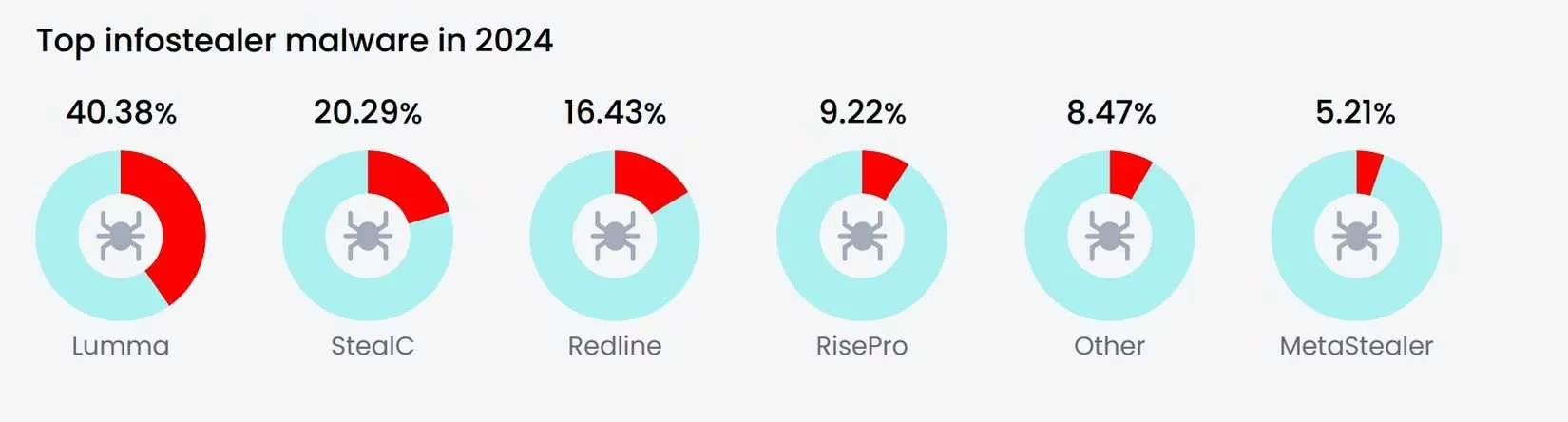
As we move through 2026, I expect infostealer attacks to keep growing in both scale and sophistication. Strains like Lumma continue to plague individuals and businesses. Staying vigilant is not just a nice idea anymore; it is essential. Use unique passwords, enable multi-factor authentication, avoid pirated software, and treat every unexpected download or verification prompt as a potential trap. Infostealer malware is far from the only online danger, but it is the one I will keep watching most closely this year.